Showing posts with label canals. Show all posts

Wednesday, 10 February 2016

Railway Stations near Canals

Canals and rivers wend their way erratically across the country, not always reaching places that are convenient to access. Here is a solution - a map and a list of Railway Stations near canals.
We have found ourselves wanting to moor up in a pleasant spot but having no easy way of getting home or even of visiting a nearby town (though Ely, see pic, is an exception).

I used Google Earth to trace the canals we planned to visit, noting railway stations up to a mile or so away from where we might moor up. We could then take the train home for a few days or visit nearby towns for a change of scene. There are 2552 stations on the Network Rail network and I've identified 290 near canals and rivers in England and Wales.
I think Google Earth is magic. There are umpteen "layers" that sit on top of the satellite images and I was thrilled to find there is a layer showing canals and rivers. So I decided to create my own layer of "railways near canals." I'll explain here how to use it, and I hope you find it useful. It's certainly a work in progress, as for many areas I have no knowledge of the ground, so I rely on you to update me and correct my data for the benefit of all.
How to set up.
Open Google Earth, or download it from here.
Now download the file  "UK_Canals_Route_Only.kmz". Click on the three vertical dots on the right in the red header and select "Download kml".  


Now import the file into your Google Earth sidebar:
(Menu: Open > and find where you saved your download)
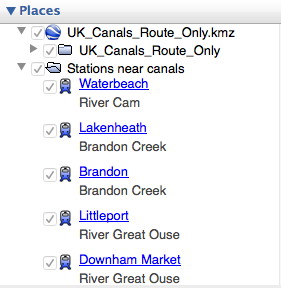


Make sure it appears in your Layers sidebar and that it is ticked. Ticked layers are visible on the map, unticked layers are not. Untick anything you don't want to give more clarity leaving those you do want to see.
Now download the file "Stations_near_canals.kmz" in the same as you did for UK Canals Route, above.
Check that this appears in your Layers sidebar and tick it if necessary. Clicking on the little triangle to the left alternately opens the list up or closes it.
 For clarity you may decide to switch off certain features such as 3D buildings, weather etc.
The selection for rail and waterways, already built in to Google Earth, is hidden in the "More" section (Layers > Primary Database > More) so open the lists by clicking on the triangle and ensure that both Rail and Waterway are ticked.
This clip shows the town of Rugby with a red dot, the railway-station-near-a-canal with a chunky blue train, a primary waterway in blue, a secondary waterway in bright green and the surrounding countryside in dark green. If you search for Rugby or click on the Rugby label in your Google Earth Places list you should see this and more!

Get Started. Now you have all the information you need to find railway stations near canals. Just browse the map using the tools at top right to zoom in and out and use your mouse to drag a route across the map.

Click on the chunky train icon to find out which canal is just a mile or so away and to get directions to and from that station.
Click on the red railway sign
to find out more about the line the railway is on and its destinations.

One other thing. The "Stations_near_canals.kmz" file can also be shown in a spreadsheet - stations_near_canals-data.xls . This shows just the unique name of the station and the nearby canal and you can search or arrange according to your needs. So you can now have a list of the nearby stations (usually within walking distance of a mile or so) for your chosen canal. Search for, or click on, the station name in Google Earth and you fly directly to it on the map, where more information can be found. 

Caution: I can't guarantee the 100% accuracy of this data. Some of it is simple rule of thumb. What seems on the map to be just a hop and a skip away could mean a lengthy detour on the ground - and is that where you really want to moor up? 
I'd encourage anyone who knows an area well to correct and amend to me, please, or in the comments box below. That way I can add to the list and we'll all find great mooring spots with railway stations nearby!

Postscript:  There is  now a Google Map site for canals and rivers. Open Canal Map doesn't specifically identify stations near canals but does show canals and rivers more clearly than the basic Google map. Try it at https://opencanalmap.uk/


Friday, 22 January 2016

Towpath Walks

I like  boating. I like walking. What better occupation than to combine the two?
So I started by Googling “towpath walks” and visited the walking section of CRT. But there, at https://canalrivertrust.org.uk/enjoy-the-waterways/walking I’m told:
“We’ve previously hosted the details of a number of different walking and cycling routes. However, when we looked at them closely we weren’t convinced that all of our routes were completely accurate.”
 They then ask me to help identify and describe canal walks for them!
Now at one level that might be a good project for me, but at the other level it doesn’t get me very far in finding canal walks and aiming my boat in that direction.

So I visited my usual walking site, Walking World. Finding the walks that use canals wasn’t obvious, but at last I stumbled on http://www.walkingworld.com/Articles/Pathways/Pathways/Canal-towpaths.aspx which has an excellent selection covering 32 counties or areas of the UK. I recommend that list, though you will need (inexpensive) http://www.walkingworld.com membership to view them.

What other alternatives are there?
·      You could wait until CRT’s collection of towpath walks is complete. Or perhaps someone has stored the (admittedly out dated) walks from the British Waterways site.
·      You could create your own using an OS map – though even where a circular route is identified you can never be sure of how accessible (surface, nettles, width etc) the towpath will be.
·      You could also buy a book of well-researched walks. I have Weekend Walks by Phillippa Greenwood and Martine O’Callaghan – an attractively photographed and well laid out selection, though few walks in the east. You can usually buy walks locally wherever there is a canal tea shop or chandlers. Julia Bradbury's books and TV programmes (also on DVD) are an excellent source.
·      More Googling shows Cool Canals with a useful list of canal walks which you’ll have to Google again for more details (The Planekeeper’s Path, Somerset Space Walk) and some free downloads.
 I discovered useful suggestions from the Long Distance Walkers Association (ldwa) site which has all sorts of publications and links.
For example, The Grand Union Canal Walk, http://www.grandunioncanalwalk.co.uk/
And Oxford Canal Walks : “A walk connecting the cathedral cities of Oxford and Coventry using the continuous canal towpath, passing 43 locks, many bridges, one tunnel and crossing only one road.”
“A series of shorter walks, the North Oxfordshire Circular Walks, with distances varying up to 14 miles, have links to the Canal walk.”

I also found TowPath Treks, a site with walks on the Leeds and Liverpool canal.

And don’t forget that, using Google Earth, you can select the canal and river option and use this as a guide to find walks near where you plan to be boating. It won’t give you the walk but it will guide you to the canal-related area.

The next step (ha!) is to decide how to walk it. Will you moor up, do the circular walk then return to the boat? Or will you venture forth leaving your boat at home? Or leave one person boating while the other walks alongside, to meet up at the next lock?
I think I prefer the moored boat, which is more relaxing and – assuming you remember where you moored it – something pleasurable to come back to. Having someone walk alongside the boat seems to me to create tension as to who is travelling faster, so I find it best if the walker goes on ahead and waits for the boat by the next lock or mooring place – which helps of course in locking through. 
Any more suggestions for sources of good canal towpath walks? 

Sunday, 11 October 2015

Ten Things I Have Learned About Narrow Boating

The original purpose of this blog was not so much the diary of events that it has become, but to describe how we use a boat and what lessons we learn as we go along.
Now, six years after first dipping our toe in the waters I wrote down these ten things I've learned in the process. If you're new to boating I hope they are useful. If you're an experienced boater I hope you agree.
1. Make sure you learn some basic engineering / maintenance skills - or, like me, have a boating partner who is skilled in practical engineering. It's not all swanning about through green avenues of trees and light twinkling on the waters, more's the pity. It also involves anti-freeze, oil, sludge, battery charging, air locks and odd things wrapped around the prop.
2. Solo boating requires special  skills and techniques. Learn about boating first with an experienced crew before attempting lock flights on your own. A longer than usual centre rope can help by holding on to the rope while working the lock gates. More info at Canal Boat - Going It Alone.
3. Cultivate a tick-over mentality. Go slowly. Really slowly. 4 mph is an absolute max when cruising, far far slower in locks, at blind corners, near moored boats etc. If your wake is breaking on the water's edge you're going too fast. No doubt a helpful liveaboard boater will be out on deck shouting at you before long.
4. There is no brake. You can only progress cautiously then engage reverse. Even in an emergency give it a moment when shifting from full steam ahead to full speed astern if you don't want to lose your gearbox. Narrow boats often misbehave in reverse, which may mean you swing around more than you'd like and steering backwards is a guessing game, but reverse gear is your only means of slowing or stopping.
5. Effective steering is only possible when you are under way and the engine is in forward gear.
6. Canals and especially locks are full of hazards. Always be aware and think how you can avoid risk or escape from a problem. Ask yourself and your crew how you would cope with running aground, getting stuck on the lock cill, become adrift with engine problems, man overboard ....
7. The centre rope is your friend. Use it to pull the boat to the mooring or keep it in place in a lock. A single mooring rope at bow or at stern will leave the other end waving around. The centre rope will pull in each end equally. Make sure centre ropes on both port and starboard are immediately available at the tiller. Extend them if boating solo.
8. Wear suitable clothing before you set off, anticipating imminent weather changes. Waterproofs, non-slip shoes, warm clothes, hat with a brim or peak against direct sun or rain. Plus a complete set of clothes to change into if the first set become wet.
9. Share the load. Alternate steering and locking, all crew need to know what to do.
10. Always greet oncoming boaters and thank lock keepers (usually volunteers) and any fellow boaters who help with locks. But beware a gongoozler who offers to help in locks, they could be very valuable but you shouldn't rely on them.

Friday, 9 October 2015

Newbold to Norton

Wednesday 23rd. There is a superb view of Venus (the planet, rather than the unclothed goddess) at 6am and at 9am in bright sunshine (at last) we set off down the Oxford towards Braunston and, we hope, Norton Junction tonight.
Passing a boat called "There and Back Again" and recognising the title of The Hobbit, I thought that could be a good title for a boating blog. After all, it's what we do.
It's a good day for boat names: I spot "Drawn to Water", "Still Thinking" (get the pun? and just "Eventually" which is very existential, I think .... And while I'm musing, or locking up the Hillmorton Locks, John tackles the shower, which does not drain properly, and discovers the fault is a blocked filter (all that hair we've lost while boating ...).
At some point I shall write a blog entry about the virtues of having an onboard engineer and shall praise the number of things he has fixed as well as those he has avoided by his maintenance regime and his risk avoidance strategies. Later he will perform annual maintenance on the engine, while in our marina - of which more later.


Arriving at Norton we find a terrible crumbling towpath between bridges 9 and 10, where netting has been erected to warn of holes and weak edges. Nevertheless we find a spot that just works - and unlike the moorings on the Leicester line we can receive TV signals.
In the evening a visit to the New Inn to encounter the UK's biggest pub bore, spouting loudly across the room throughout our meal, meaning we have to move seats to a quieter area next to the skittle game.

Back on board we seem to have entered a parallel universe as the TV news features Prince Harry laying a patio and various improbably dressed rugby fans speaking incomprehensibly in Scots and Japanese. The new Lib Dem leader looks like a young Brummie footballer sporting cropped hair, unfeasibly expressive eyebrows and a line about being brought up in the shadow of the gas works that sounds like Monty Python's Four Yorkshiremen.

Thursday 24th. Shooting through the Watford locks in good time we head on untroubled towards Welford with good weather and nothing to slow us down. The journey home has to be by road via Snarestone to pick up the second car. Rush hour plus problems on the A14 provide an unsatisfactory way to end a great trip. We recommend The Ashby Canal!

Back down The Ashby 2

Tuesday 22nd. Overcast with occasional rain showers. This is not how it's supposed to be! We pass Charity Wharf with its bizarre collection of mad dummies and decaying boats. Funny how these don't feature in Waterways World ....
We reach the Marston Junction, a place of many pylons, between The Ashby and the Coventry canals and make a very sharp turn into the Coventry for a few miles before reaching Hawkesbury and another big turn into The Oxford.  I'm singing Paul Simon "I hear the drizzle of the rain, like a memory it falls ..." and I'm feeling full of reminiscence, but the canal pulls me on. A pair of swans with an extraordinary eight cygnets all shimmy alongside in a long string and I'm back to concentrating on the water ahead.

Our continuing journey to Newbold is peppered with brief heavy showers followed occasionally by a blast of sunshine to warm our backs and light up the cut, revealing the first autumnal hints which hide invisibly when it rains. At one stage the rain falls so fiercely it peppers the surface water making it look like a rough and muddy farm track.
But it's the equinox and evening brings calm and golden rays. Mooring at The Barley Mow next to the Newbold tunnel we are alarmed by a threatening clunk from somewhere down in the bilges. Turns out there is a protruding ledge at the moorings and, concerned that this might damage the hull, we tie the gangplank to the side to act as a large fender. It works well and, thanks to a couple of pints and a good meal at The Barley Mow, we sleep undisturbed.

Back Down The Ashby 1

Monday 21st. Patience has been moored quietly at Snarestone for a week while we rest up at home, but now it's time to head back down the Ashby and get Patience to her moorings at Welford.
Leaving one car at Welford we go on to Snarestone, arriving at midday, unload the car and off we go, leaving the tunnel, the newly opened extra mile and The Globe behind. It's raining heavily but there's nothing to be gained by mooring up (though The Globe is tempting) so we trundle on, pausing only to pump out our foul tank in a nearby marina between bridges 42 and 43. Foul explosions averted, eventually the clouds clear and the sun starts to dry us out as we slowly retrace our path down The Ashby towards Braunston.

Approaching a bridge we spot eight people in a newly hired boat struggling to avoid us, the bridge and everything. Five of them are on the tiller, which presumably is part of the problem as they career across the canal. Whatever advice they've been given about steering seems already to be lost. Note - take especial care where hire boats start out. And to new hirers: it looks easy but it takes a bit of practice!


Elsewhere, on what is the most peaceful and beautiful northern section of The Ashby (eg bridge 20, pictured), I spy a solitary fox on a field edge 50 yards from the boat. Unaware of us he basks in the sun, trots up and down a bit, red pelt glowing in the afternoon sun. As a poultry keeper I have a special loathing of the fox, but here, basking innocently in the afternoon sun (and therefore nowhere near my hens) it is a sight to see.

At 6.30 we arrive back at Lime Kiln, mooring up just yards from where we were on the way up, by the water point near the bridge (15).  Again a lengthy boat or two has taken the quieter section opposite the pub car park, but we're happy to have made the distance, survived the rain and to be well fed at Lime Kilns.

Friday, 25 September 2015

Westward Ho!

Home from retrieving Patience from Snarestone and bringing her home to Welford, while I organise my diary, it's good to look at our explorations so far, from 2009 to 2015.


See how the yellow lines are spreading as we find new canals to explore.... (click on the map for a larger version)

Sunday, 19 April 2015

Ulverston Canal

Don't get your hopes up - this is not navigable in the usual way. Though the canal is in water and is not only the deepest and straightest of our canals, this is also the shortest and leads directly from Ulverston in Cumbria into Morecambe Bay. Completed in 1796 it's 1.25 miles long, 15 feet (4.6 m) deep and 66 feet (20 m) wide.
It's also rather attractive, once you fight your way through the industrial buildings.
Apart from the curiosity value of this isolated short canal it is interesting for its unusual rolling bridge. Looking over the bridge (now a fixed footbridge) there are clear signs that this was once a movable structure with wheels and beams at an angle to the river edge. Yet it was only recognised as a rolling bridge quite recently.
Exactly how it worked I leave to others to explain (read this for example or the Wikipedia entry) but it evidently rolled, or perhaps swung, on its wheels to allow both rail traffic go across and water traffic go beneath.
The adjacent building was the accumulator house for the hydraulic movement that swung the bridge into a recess in the bank.
And by the way, though I gather the Ulverston canal may be straightest and shortest in England there must be a place for the Arisaig canal in Scotland (below), which is surely shorter than Ulverston, though it has a single slight bend. Which is the UK's shortest?


Wednesday, 5 November 2014

The story so far ....

Just for the record I thought we should have a little map (there's a larger version online) of the rivers and canals we've covered so far, since December 2009.

Our travels are in yellow and start in the east on the Great Ouse and its tributaries The Cam, Lark, Little Ouse and Wissey, not forgetting the Lodes at Wicken, Burwell and Reach.
Then just before we meet the Wash, the other side of the Denver Sluices, we head off through the Middle Levels to the River Nene.
After a stay at Oundle we progress to The Grand Union (Northampton Branch, Leicester Section, Welford Branch and Market Harborough Branch).
Most recently we've been back to the Grand Union at Braunston with a very brief trip down the Oxford Canal (South).
To be continued ....

Monday, 30 November 2009

How it all started

Just thought it was worth mentioning that, like many of the best things in life, this all happened by chance.
My daughter Sarah wanted to rummage around the Emmaus second hand warehouse near Waterbeach so I offered her a lift. When she'd finished we went for lunch at The Lazy Otter, a pub I'd seen advertised nearby but never visited. Arriving with time to spare we wandered down to gaze at the boats and saw a for sale sign. "How much are narrow boats?" asked Sarah. Not having a clue I pulled out my mobile and rang the number on the sign.
By chance the owner was on board and kindly showed us round.
That got my interest going and led in only a short time to a conversation with my friend John, an engineer now with some time on his hands who himself visited the boat. As it happened this boat was quickly sold to someone else, but he told us of another boat for sale just yards away and that is how Patience came to our attention.
All because Sarah needed a lift. And thanks to The Lazy Otter.

Ready for a Survey

We're now booked in a for a survey with a marine surveyor. We've set great trust in Alan who's selling Patience, but it's important to know the state of Patience's bottom (ouch!) and whether there is any serious maintenance required.
Alan and John will put her into dry dock for the inspection and if the results are favourable we can decide firstly whether to buy her and secondly whether she needs work, such as blacking her bottom. Depending on water conditions a narrow boat may need blacking every two or three years. We must also find out about her "sacrificial anode". This is defined as "An anode attached to a metal object, such as a boat or underground tank, to inhibit the object's corrosion. The anode is electrolytically decomposed while the object remains free of damage." So it sounds like a good idea to have one, though it's tough on an innocent anode ....
And if all that works out we might then get on with choosing a solar panel, changing the sleeping arrangements and winterising her for the cold days ahead. Not to mention paying for her mooring, insurance, cruising certificate and other things about which we currently know little.
But it makes it easier to suggest things for us this Christmas. A little something from the chandlery collection perhaps?